Reflections on art and leadership

I use my art to reflect an artist and a senior manager in the financial services industry. I notice that the deeper I understand myself the more I succeed to impact others; in both art and work.

Sunday, March 24, 2013

philosophy and clichés and art and me

Recently I have been looking into what philosophers over time have said about art and aesthetics.
I plan to write more about different philosophers, their ideas and how they could impact the way I view my art or even how I will make my art going forward. This is all part of a desire to develop a deeper understanding of art, maybe even as a contrast to all experiences of myself and other artists focusing on showing work in exhibitions; something not essential to art.
This time the topic is inspired on Immanuel Kant for his concept of understanding art and beauty as well as a biography on Albert Einstein where it shows how he uses metaphors and insight to create insight on very complex subjects.
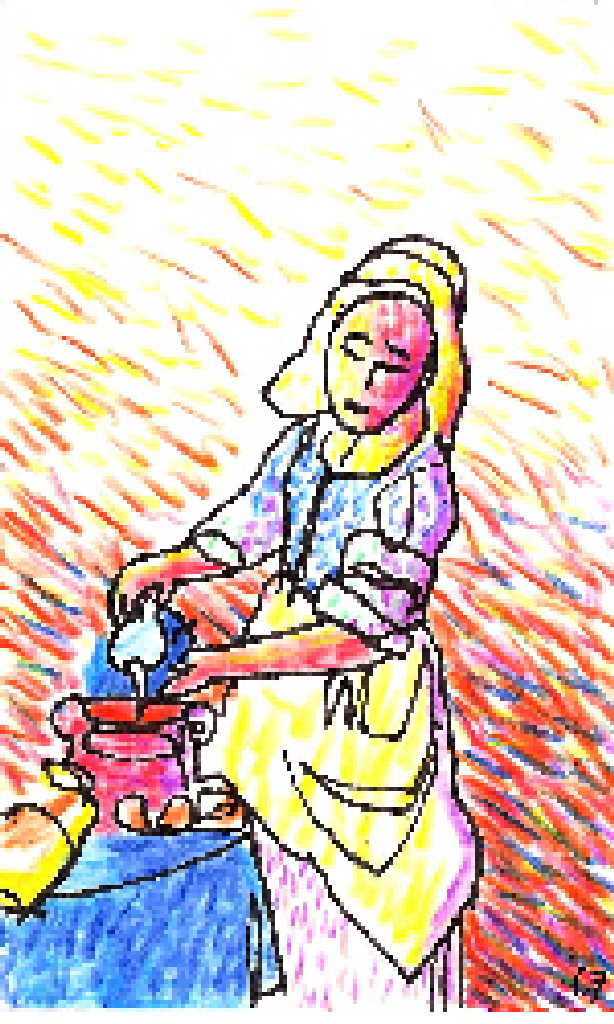
One of my first small drawings
Copying Vermeer's painting
Is this a cliché, or just practice
Clichés in art

Definition of cliché would be something like:
a phrase or opinion that is overused and betrays a lack of original thought (Oxford dictionary).

I would say that when looking at art a cliché is an art work that is known by many and initially has become a symbol of a genre or style. And at current times this has become so well-known and 'seen' that it has lost its power to touch people at first sight.
This idea also aligns with a definition listed in wikipedia of cliché which enlarges the scope of the definition to art:

A cliché or cliche is an expression, idea, or element of an artistic work which has become overused to the point of losing its original meaning, or effect, and even, to the point of being trite or irritating, especially when at some earlier time it was considered meaningful or novel

Interesting is that some paintings represent a cliché to domain experts, but not to the wider public.
Definitely full of cliché
But several people liked it...
This is also the reason that philosopher Hume defines 'knowing many similar art works' as a condition of being a true critic of beauty.
As an example; People not familiar to the distinctive paintings of Gustav Klimt might be touched by such a painting; they might even enjoy a new painting by a painter that mimics Klimts' style and expression.
Domain experts will of course still value the original painting, but whenever a painter sort of copies too clearly the original it will be seen as cliché.
In addition the cliché paintings lose their ability to deeply touch us, as we have seen it many times before, and this even distracts us from appreciating all the beauty in this art work that at some point in history represented a new and unique view on reality.
Examples could be: the Mona Lisa, the self portraits of Van Gogh, and the Creation of Adam by Michelangelo. They were originally revolutionary, but at first sight are no longer touching us as deep as it has touched the original audience at the time it was created.

Why is this relevant?

In history several philosophers have looked at art, at the pleasure we derive from art objects, at the definition of beauty. And on how our 'universal pleasure' looking at a new work of art gets constructed.
Portrait of Danish philosopher
Sören Kierkegaard
Original thinker and inspiration
Philosopher Immanuel Kant in his Critique of Judgement expresses the view that we obtain a pleasure from viewing when an understanding is combined with triggering our imagination. More strongly he believes that we can only build imagination if it combines concepts that we know.
Consequence of his view would be that, if we see an object and have no clue what it is about, we will not be able to understand it nor appreciate its beauty.
We grow up concatenating impressions and interpretations of art works, and those we see many times and what they represent become part of our vocabulary, our foundation, formed by clichés.
When looking in this way to art and new creation, and how they build on existing concepts  in a way:
- clichés are the subconscious building blocks that the artist uses as a foundation for creating his/her new view on the world, materialising in the art works
- clichés are the starting concepts that help the viewer understand the art work, see what it was based on and appreciate and enjoy the new aspects that were added by the artist.

What can we conclude from this?

Several conclusions can be derived from these few ideas and statements, some more impacting than others.

1. the clichés as part of the artistic journey
Definitely cliché
Somehow embarrassed that I made this
But has to be shown here I guess
When an artist just mimics what has been done in the past his work will be seen by experts as 'cliché', although the wider audience might appreciate it for its basic expressive values.
Many artists in the beginning opf their carreer create art works that are subconsciously a copy of what has already been done. These cliches are so much part of them that it takes a lot of time to 'live' them and surpass them to obtain the basis for truly free and new expression. In a way the clichés are the building blocks for future innovative art works. And these innovative art works will become the cliches of the future.
Personalmly I even observed this in my own art in several ways.
- The first art works were highly influenced by earlier examples I had seen, and in many cases aiming to please people I valued.
- I also observed this in a similar but different area where I have been making cartoons. Initially when I wanted to make truly distinctive cartoon characters, yet still once they were finished they always ended up looking very much like my own favorite cartoons. I observed the same concepts when teaching people about making cartoons by the way.
As Picasso supposedly said: every artist needs to go through at least 500 art works before being able to create truly original work.
An interesting theory that seems to relate to the same concept is the Helsinki Bus Station Theory; read the article here
Drawing I made of my oldest son, still captures me every time I see it.
Odd is the role of the red/magenta...not conventional, but quite expressive

2. Tempation of becoming a designer
If an artist actively continues to mimic and use previous well-known art forms to ensure the broader public likes the art works, this is more 'design'. The role of the designer is to please the public; the purpose of an artist is more to find his/her own new path based on the paintings, concepts and images of his/her ancestors.

3. creating new concepts to touch the audience (and oneself)
If the artist in fact desires to touch his audience in a deeper, more than just aesthetic way, he/she needs to create a personal new path to the existing clichés  and surprise the viewer; making the viewer go in awe when seeing the object.
In some cases the artist uses (a) a new way of seeing the world, and (b) sometimes an artist can use new technology to add dimensions to the art work. Examples could be:
1. Seurat basing the pointillism on the new colour theory, using basic contrasting colours next to each other to obtain a more vivid image. Later this was used by Van Gogh, who supported the concept, but felt the pointillism was too rational, not allowing free expression. He then came up with his renowned expressive style using quick brush strokes.
2. Impressionism based on the invention of the paint tubes, and the possibility the artists had to then go out in the fields capturing their impressions directly on the canvas.

4. bridging the gap between artists new concepts and the audience
Drawing made of a
fado singer in Lisbon
In addition the continuous re-invention of art and its concepts by artists implies a large set of concepts (often clichés to the artist) to be known by the viewer in order to understand the art object. And just by reason we can conclude that this gap between artist and the 'average' viewer will further increase over time.
Some artists contribute to closing the gap in two ways (while others couldn't care less):
1. providing material explanation concerning the art work; ensuring that the viewer has a basic understanding of the artists concepts. At the same time not over-explaining as it reduces the space for the imagination of the viewer.
2. ensuring the art object remains appealing in a classical sense; allowing the viewer to appreciate and explore gradually the deeper meaning and concepts of that art work.
This also explains the view that my mentor Frederik Beerbaum expressed: Maurice, do not worry about the opinion of your viewers, more than 95% of them has no clue about what painting is about...

5. Historic perspective
cliché or authentic ?
or authentic cliché ?
Some people might raise the point that these concepts have not always applied to art, as at some point for example most art was made as commission; and the primary purpose of that art was to please the mecenas that had ordered the painting. We do see however that even at that stage the artists had a drive to renew their vision, to add something new. Whether it was renewed perspective, new techniques, new compositions or new expressions.
Some other aspects seem to be relevant when looking into art from a historic perspective:
- the artist getting bored making each time the same thing that he has done many times before, searching for a new challenge and new variations or specialisation
- the artist hiding certain innovative aspects in the traditional form, invisible for the 'dumb' audience but very clear for the more trained viewer
- the fact that also the person ordering the art work was always proud to show that he had something 'special', as long as it was close enough to the aesthetic values of that time.
As such I think there are sufficient examples showing that the aspects of clichés and innovation have played a role already for a longer period time.

Limitations:
- Limitation of Kants view is that he only looks at the pleasure of viewing a beautiful object, where we could challenge whether that pleasure is actually the true purpose of art objects. In addition I will study the critics of Kant, as a large part of this article is based on his views. Still, I feel the view of Kant is relatively straightforward and in line with insights I have obtained before.
- before mankind there was no art, and even at the early stages of mankind there was no art. Or more precisely, the earliest evidence of art dates from the stone age. It is however difficult to assess whether this was more decoration or truly art in its current from and definition.
- of course not all building blocks and experiences that we build our new thoughts on are per definition clichés; but the interesting part of clichés is that they have so much become part of ourself that we do not observe them any more, even when we use the ourselves.

What does this mean for my art?

The purpose of this article is primarily for myself, forcing myself to give words to my recent thoughts, and in such a way consolidating the progress of my insight in art. The same accounts for my art. And because of that it seems good to see what conclusions I should draw from the above; where can it help me.

Well, I need to study the basics, and look for new elements to be added that exceed the expression and quality of the clichés. At the same time I think that after all very interactive and outgoing experiences of last year I will re-focus on the quality of my journey, ensuring I stay close to myself, close to that young boy that was once so deeply fascinated and energised by drawing, by seeing paintings that brought something new.
I guess as an artist we try to combine the child that is exploring the world in full openness, with the expressive power of the experienced artist.

I have made hundreds of drawings over last 2 years. Several drawings are pure cliché. It is funny to observe that most people prefer these drawings that are more cliché to me. Only when you stimulate them to observe and really see the other drawings they sometimes start to build a deeper fascination.\Maybe the best drawings combine newness with traditional quality or expression and colours, alluring the viewer to be fascinated and exploring the many aspects of the work of which some are more hidden and indirect. As such the art work builds the bridge between itself and the viewer, without explanation. And I should probably define how I build the bridge between my art and the (possible) audience. In the past I had the approach that I would share the context of the art work with my audience, but not explaining the actual meaning. This allowed people to build a bridge with the art work, yet have the space to create their own interpretation and appreciation.
Not the most beautiful self-portrait
But what type of portrait can we still make without ending up in clichés

And now, stop writing, stop thinking of art, find myself in art and retrieve the initial passion and drive to draw and draw and draw.

Sunday, February 17, 2013

Plan 2013 Step 1 - Evaluating 2012

When looking at my own objectives it is funny to observe that I wrote them down in a small booklet, but did not spend lots of time writing updates. Guess it tells me to not over-engineer this evaluation, as it does not give lots of energy.
Still, good maybe to structure my evaluation in the way it would b done in a business and leadership context.
Key elements there are:
- Clear guiding image of the target (direction) - I would call it Beatrice (the guiding image that helped  Dante overcome his challenges in La Divina Comedia)
- Defining scope
- Exploring the way to the target

I. High level view of 2012 plans

1. Beatrice
The key elements of focus for myself had been:
- developing my insight into myself
- improve understanding of art
- starting to understand the way the art world works, and define how I would like to deal with marketing

2. Scope
I had focused mainly on learning, experimenting and describing my journey.
Actual marketing and expositions cam on a second priority, as i feel I still have a lot to develop as an artist.
And as I am not a full time artist I need to focus.

3. Exploring
Elements I had planned:
- continuous feeding of my conscious and subconscious with art, drawing, etc
- writing on my blogs to capture experiences, ideas and insights
- develop a consistent web-presentation: forcing myself to structure my own thoughts and ensure my ideas and artworks are easily accessible.
- explore selling through internet

II. Key observations
- website has been restructured, and the many blogs have been set up. I have not been able to keep them updated as planned - idea was a weekly article.
- website has played a key role in being found by New York galleries. Mainly after the article about my parchment objects on my blog I received the actual invitations from 2 New York galleries.
It all started with the art works I made as a commission for collectors Mr and Mrs Maas
I made 2 parchment objects called 1. Scapegoat and 2. Sacrifice
- the blog www.mauriceblog.org has helped me to be more concrete and document my ideas and concepts.
- The  Art Burshy cartoon published at www.ArtBurshy.com has proved to be very close to myself, and helps me to express some less conventional views in form of humor. It also proved to be relatively easy to maintain (except a period of some 10 weeks).
- web visitors have raised to a level of around 2000 monthly visitors for the 3 websites by end of December, in combination with the many articles about my New York exhibition.
- key drivers of page visitors:
   > weekly content published
   > distributing articles through facebook, twitter. And some that have a business-focus to LinkedIn
- when being approached by Agora Gallery I decided to still go for an exhibition, although it had not been the focus.
- I started an interview with Frederik Beerbaum, and this brought quite some insight already. Want to to follow this up in 2013, probably during summer holidays.
- I have tried to discuss purpose of art with several artists. Many of them couldn't care less. I discovered that many of the questions I have raised are not 'popular' and only a handful artists were actually interested, and then were able to help me develop my views.
- I did the Barcelona exhibit and visited the Amsterdam equivalent. Conclusions of these exhibits:
  >> these events draw a lot of random visitors, not many interested in art (nor in buying)
  >> if you just have paintings you are lost in the chaos and massive amount of other artists
  >> quality of art, in sense of skill|concept richness|emotional charge is generally very limited
  So for me, if I will participate again I will make something that stands out more, is maybe more bizar/screaming/shocking
- I have concluded that by now I have lots of art works, several have been sold, but quite some remaining. I feel that initially I had a focus on 'creating', producing almost from a desire to be present. Now I see that actually the quantity has been useful to train and develop my skills. I feel that in coming time I want to focus more on exceptional art.
Basically this imples a move from 'quantity' to 'quality'.

III Shifts in thinking
The things that seem to differ now when looking back, and might change the focus of working:
1. From quantity to quality
Spending more time to research on subjects, study ancient techniques, take time for prototyping, rethink concepts or combine them to deepen the impact they have.
2. Keep focusing on content of writing
Although last year websites helped to market my art, I still feel primarily I should use the blog to explore and express ideas. Not to watch too often at the number of page visits.
3. Keep developing Art Burhsy cartoon
The Art Burshy cartoon is a nice way to spontaneously express controversial ideas, and stimulate myself and others to think. Also I would like to explore this year if there is a way to achieve publishing it in paper, magazine or so.
4. Take time to explore of the purpose of art (in general and for myself).
Finding more backgrounds and historic views of art and philosophy, and how this impacts myself as an artists.
Work on the interviews with Frederik Beerbaum and identify some key topics for exploration.
See if I can take part in a contest/concours that forces me to deepen my concepts, yet still achieving aesthetically appealing art works.

The parchment art works Scapegoat and Sacrifice are an example of target concepts
where I did more research and
where I feel I achieved a combination of a very rich concept and an aesthetically appealing object.

So far evaluation of 2012, ready for the next step to define my plans for 2013.
Pushing myself to write that for next week, as we are mid February already...

Sunday, February 3, 2013

How does an artist set objectives for 2013

Standing with one foot in the art world and with the other foot in business creates an interesting enrichment from each side to the other: art helps me to reflect, take distance and adjust in the business world. Business allows me to be efficient and effective in my art efforts.

One of the elements I try to do since 2 years now is make my objectives for the year a bit more explicit. I have the feeling it helped me:
- get a better focus on what I want to achieve
- ensure I spend enough time on art creation as well as other aspects such as marketing and exhibitions
- be clear on what I will NOT do and obtain material result while being limited in time
- push myself beyond where I am today; and has pushed me out of my standard patterns and initial (somewhat) more cliche painting subjects

Why have objectives and direction
Looking at some research I noted the following about artist objectives:
- many art marketing books state that an artist should set objectives and also define a marketing plan
- philosophical and psychological books identify the 'lack of objectives' as one of the key reasons for artists to stop making art
- in fact, it shows that
   a) objectives should not be too concrete and reachable; it is known that artists freeze once objectives have been met and there is no new stronger objective on the horizon
   b) objectives should not be too far away as they might become demotivating when the artist discovers how far he is away from reaching them after a few months
- although the primary focus of an artist normally is a deeply internal motivation, the artist is also an entrepreneur and needs to keep developing his strategies and approaches; standing still is like losing time
- formally writing down your objectives makes it possible to evaluate and learn about which elements you can influence, which items are more difficult, and what are key areas to improve.

Counterarguments sometimes heard from other artists (and in business too by the way):
- you can not really plan and predict everything
- you just have to be lucky to be discovered
- art is not about finance, it should remain pure and an organic approach can be as good as a planned one.

In fact, in the basis all these elements are true....
But in my case I would say:
- the fact that I can not predict the road ahead does not mean I should not at all where I want to go and which road I plan to take
- we can hope for luck to cross our path, and try to help it a bit
- 'over-engineered planning' indeed creates too much structure, provides a fake sense of control and can destroy inspiration and energy; so let's define our goal, see what we do and don't want to include in our journey preparation. And then travel the road organically along these lines, making it an iterative learning experience.

Steps when setting objectives

I am taking 2 weeks to develop my objectives for this year. To force myself to be realistic and explicit I will share the key elements on my blog. This will also help to get later feedback from other artists, galleries and people I consider my mentors.
To get to my target objectives I plan to go through the following steps:

1. Evaluation of 2012
In this evaluation I would like to include:
- what were my objectives of 2012 and to which extent did I reach them
- what were the key activities I did and how did that go
- where did I not meet my expectations, and how can I get clarity on the reasons for that
- where did it go surprisingly well, and can I use more of that next year
- where did others help me get new insights, have better results.
- which elements gave me  energy and which have cost me energy
- which elements had I overlooked; also for aspects as cost, issues, visitors, suppliers, etc.
- is my view of myself as an artist, my strategic direction and vision still intact. Are there reasons that challenge my ideas or could enrich my view.

2.Refine my personal dream, view and approach
As an artist I have a dream, an idea of what I would like to achieve with my art, in a sense this dream is the 'muse' that drives me and makes me get up every morning full of energy thinking of art and life (well, almost every morning). It is good to make this dream concrete and make it subject to a bit of a sanity check.
Changing my objectives marginally while forgetting to face the brutal truth about my dream would imply spending lots on hours on a journey that is not for me to travel....
In practice this means that I will ask myself the following based on the evaluation of step 1:
- how can I enrich my views; which elements to add
- are there things I should consider for thorough review
- can I involve other people to get more clarity on how to approach certain items
- can I still justify my self-image about my talents, pitfalls, challenges and life approach, or are there multiple signals that suggest I should re-assess some of the points

3. 2013 Objectives
Which elements would I like to reach.
Where a key element is still how to remain energised, not make the objectives more important than the joy experienced and shared with others.
Already when writing this article I feel that the idea of having to finish a structured article makes my energy flow away.

4. Approach and planning
It is good to make some things practical; ensure there is a drive to push myself forward.
And translating the objectives in some concrete steps, but leaving the space to follow new things, experiment with new techniques, enrich my views by sharing with others etc.

5. Sanity check
After all has been written good to do a quick sanity check; is it all realistic, how will it work, what are my personal strengths that are required and my weaknesses that will stand in the way.

6. Go for it
Still important just to go out there, experiment, be heavily disappointed, ensure to live a full life, reflect and make all that part of my art, and make art part of that life.

Well, enough talked so far about my intentions and ways I would like to create a small plan. Especially having been offered several places to exhibit, need to work on some art works, be passionate and use the structure to help broaden my horizon and deepen my engagement with life.